If you run a small business, you have probably asked yourself this at some point:
Should I spend money on Google Ads or Facebook Ads?
It is a fair question. Especially when every platform, marketing person and business guru seems to have a different opinion.
Some people will tell you Google Ads are the best because they target people who are already searching. Others will tell you Facebook Ads are better because they are cheaper and great for building awareness. Annoyingly, both of those things can be true.
That is what makes the Google Ads vs Facebook Ads debate slightly tricky. It is not always about which platform is “better”. It is about which platform makes the most sense for your business, your audience, your offer and your budget.
Because let’s be honest, most small businesses do not have thousands of pounds to throw at ads just to “see what happens”. You need your marketing budget to work hard. You need to understand where your money is going, what results to expect and which platform gives you the best chance of turning clicks into customers.
So, in this guide, we will break down the difference between Google Ads and Facebook Ads in plain English. No jargon overload. No pretending paid ads are magic. Just a practical look at how both platforms work and when each one might be the better choice.
- What Is the Main Difference Between Google Ads and Facebook Ads?
- How Google Ads Work
- How Facebook Ads Work
- Google Ads vs Facebook Ads: Which Has Higher Intent?
- Google Ads vs Facebook Ads: Which Is Better for Awareness?
- Which Platform Is Cheaper?
- Which Platform Converts Better?
- When Should a Small Business Use Google Ads?
- When Should a Small Business Use Facebook Ads?
- The Problem With Choosing the Wrong Platform
- Google Ads Are Not Magic
- Facebook Ads Are Not Magic Either
- What About Retargeting?
- Should You Use Both Google Ads and Facebook Ads?
- What Should You Choose if You Have a Small Budget?
- Which Is Better for Local Businesses?
- Which Platform Is Better for B2B Businesses?
- Which Platform Is Better for E-Commerce?
- Common Mistakes Small Businesses Make With Paid Ads
- So, Google Ads vs Facebook Ads: Which One Is Better?
- Final thoughts
What Is the Main Difference Between Google Ads and Facebook Ads?
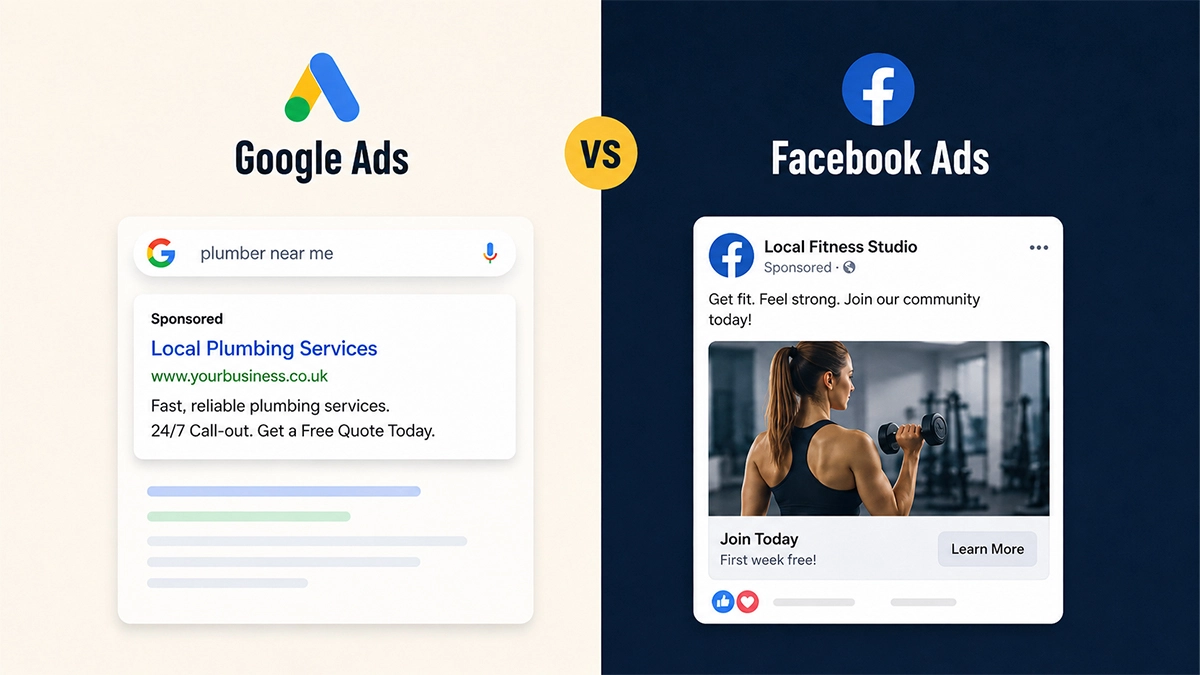
The biggest difference comes down to intent.
Google Ads usually target people who are actively searching for something.
Facebook Ads, which also include Instagram Ads through Meta, usually target people based on their interests, behaviour, demographics and online activity.
In simple terms:
Google Ads help you get found when people are already looking.
Facebook Ads help you get in front of people before they start looking.
That one difference changes everything.
For example, someone searching “emergency plumber near me” on Google probably needs a plumber right now. They have a problem, and they are looking for a solution.
However, someone scrolling Facebook might not be looking for a plumber at that exact moment. But they might see a local plumbing company’s advert about boiler servicing before winter and think, “Actually, I should sort that.”
Both approaches can work. But they work in different ways.
How Google Ads Work
Google Ads allow businesses to appear in Google search results, on YouTube, across websites and in other Google-owned placements. However, when most small businesses talk about Google Ads, they usually mean search ads.
These are the sponsored results that appear at the top of Google when someone searches for a product or service.
For example, if you own a local accountancy firm, you might run ads for searches like:
- accountant near me
- small business accountant
- bookkeeping services
- tax return help
- accountant in Nottingham
When someone types one of those searches into Google, your advert can appear above the organic results. If the person clicks your ad, you pay for that click.
That is why Google Ads are often called pay-per-click advertising, or PPC.
The big advantage is that you are reaching people who already have some level of intent. They are not just randomly browsing. They are actively searching for something related to your business.
That is powerful.
However, it also means competition can be high. If lots of businesses want to show up for the same keywords, the cost per click can increase quickly.
How Facebook Ads Work
Facebook Ads work differently. Instead of mainly targeting what people search for, they target who people are, what they are interested in and how they behave online.
Through Meta Ads Manager, you can place ads across Facebook, Instagram, Messenger and the wider Meta network.
You can target people based on things like:
- Location
- Age
- Interests
- Behaviours
- Previous website visits
- Engagement with your social media pages
- Lookalike audiences based on existing customers
This makes Facebook Ads very useful for awareness, promotion and audience building.
For example, if you run a fitness studio, you could show ads to people in your local area who are interested in fitness, running, Hyrox, weight training or healthy living.
Those people may not be searching for “fitness studio near me” today. But if your ad is strong enough, you can still grab their attention.
This is why Facebook Ads often work well for visual businesses, lifestyle brands, events, offers, local promotions and products that people do not necessarily search for directly.
Interested in building awareness with Facebook ads?
Check out our social media services
Google Ads vs Facebook Ads: Which Has Higher Intent?
Google Ads usually win when it comes to intent.
That is because people are actively searching for a solution.
If someone searches for “website designer for small business”, they are probably much closer to taking action than someone casually scrolling Instagram.
They may already know they need a website. They may already have a budget. They may already be comparing options.
As a result, Google Ads can be very effective for services where people know what they need and are ready to enquire.
This includes businesses like:
- Trades
- Accountants
- Solicitors
- Dentists
- Clinics
- Web designers
- Consultants
- Repair services
- Local service providers
However, high intent often comes with higher costs. If a keyword is valuable, other businesses will probably be bidding on it too.
So, while Google Ads can bring in better quality traffic, you may pay more for each click.
Google Ads vs Facebook Ads: Which Is Better for Awareness?
Facebook Ads usually win when it comes to awareness.
This is because you can put your business in front of people who may not know you exist.
That is useful because not every customer starts with a Google search. Sometimes, people need to see your brand a few times before they trust you. Sometimes, they do not even know they have a problem yet. Sometimes, they need a little nudge.
Facebook and Instagram are especially useful when your advert can tell a story visually.
This could include:
- Before and after photos
- Product videos
- Client testimonials
- Behind-the-scenes content
- Team introductions
- Event promotions
- Limited-time offers
- Educational posts
For small businesses, this can be a great way to stay visible locally.
For example, a local café might not get many people searching “independent café near me” every day. But if they show mouth-watering photos of their food to people within a few miles, they can build interest and footfall over time.
That is where Facebook Ads can shine.
Which Platform Is Cheaper?
This is where things get a little awkward.
Facebook Ads often have a lower cost per click than Google Ads. However, cheaper clicks do not always mean better results.
A £0.50 click from Facebook is not useful if the person has no real interest in buying. Likewise, a £4 click from Google may be worth it if that person becomes a customer.
So, instead of only asking which platform is cheaper, ask:
Which platform is more likely to generate the result I actually want?
That result might be:
- Enquiries
- Bookings
- Calls
- Purchases
- Email sign-ups
- Quote requests
- Event registrations
- Brand awareness
For many small businesses, Google Ads can feel more expensive because the clicks cost more. But those clicks may come from people with stronger buying intent.
Facebook Ads can feel more affordable because you can reach more people for less. But you may need a stronger follow-up process to turn that attention into enquiries.
In short, Facebook may be cheaper for reach. Google may be better for intent.
Which Platform Converts Better?
Google Ads often convert better for direct-response searches.
That means if someone has a clear problem and they are actively looking for a solution, Google Ads can perform very well.
For example:
- “emergency electrician”
- “private physio appointment”
- “wedding photographer Nottingham”
- “small business website design”
- “boiler repair near me”
These searches show clear intent.
However, Facebook Ads can convert well too, especially when the offer is strong and easy to understand.
For example:
- Free trial classes
- Discounted first appointments
- Local events
- Online courses
- Low-cost products
- Lead magnets
- Seasonal offers
- Retargeting campaigns
The key difference is that Facebook usually needs more warming up. People may click because they are curious, not because they are ready to buy today.
That does not make Facebook bad. It just means you need to use it properly.
When Should a Small Business Use Google Ads?
Google Ads could be a good choice if people are already searching for what you offer.
This is especially true if your business solves an immediate problem or provides a service that people actively compare before buying.
Google Ads may be right for you if:
- Your service has a clear search demand
- People already know they need what you offer
- You want enquiries, calls or bookings
- Your profit margin allows you to pay for clicks
- There is a clear landing page on your website
- You can respond quickly to leads
- You know which locations you want to target
For example, if you are a local tradesperson, Google Ads can be a strong option. People often search for trades when they need help quickly.
The same applies to clinics, professional services and businesses where customers are actively researching providers.
However, Google Ads work best when your website is ready. If your landing page is confusing, slow or vague, you may pay for clicks that never turn into leads.
And that is painful. Like “checking your bank account after a weekend away” painful.
When Should a Small Business Use Facebook Ads?
Facebook Ads could be a good choice if you need to build awareness, promote something visual or reach a specific type of person.
They work especially well when your audience may not be actively searching yet.
Facebook Ads may be right for you if:
- Your product or service is visual
- You have strong images or video content
- you want to build local awareness
- you are promoting an offer or event
- your business relies on trust and familiarity
- you want to retarget previous website visitors
- you want to grow an email list
- you have a clear audience in mind
For example, a gym, café, beauty salon, clothing brand, coach or event organiser may benefit from Facebook Ads because the platform gives them space to show personality and build interest.
Facebook Ads also work well for businesses with longer buying journeys. If people need to see you a few times before enquiring, Meta can help keep your brand visible.
Interested in building awareness with Facebook ads?
Check out our social media services
The Problem With Choosing the Wrong Platform
A lot of small businesses waste money on ads because they choose the platform before they understand the goal.
They say, “Let’s run Facebook Ads,” because they have heard Facebook is cheaper.
Or they say, “Let’s run Google Ads,” because they want quick leads.
But neither platform works properly without a clear strategy.
Before choosing Google Ads or Facebook Ads, you need to know:
- What are you promoting?
- Who are you targeting?
- What action do you want people to take?
- Is your website ready to convert visitors?
- How much is a lead worth to your business?
- How quickly do you need results?
- Do people already search for your service?
- Do you have strong creative assets?
Without those answers, you are basically throwing darts in the dark. Brave? Yes. Sensible? Not really.
Google Ads Are Not Magic
Google Ads can be brilliant, but they are not magic.
You still need:
- The right keywords
- Strong ad copy
- A clear landing page
- Proper conversion tracking
- Negative keywords
- Location targeting
- Regular optimisation
Without those things, Google Ads can burn through your budget quickly.
One common mistake small businesses make is sending all ad traffic to the homepage.
Your homepage might be lovely. It might have nice photos, friendly copy and a beautifully placed button. But if someone clicks an ad for a specific service, they should land on a page about that specific service.
For example, if your ad promotes “logo design for small businesses”, the click should go to a logo design or branding landing page, not your general homepage.
That keeps the journey clear.
Clear journeys usually convert better.
Facebook Ads Are Not Magic Either
Facebook Ads also need proper planning.
Boosting a post for £20 and hoping for the best is not really a strategy. It might get a few likes, but likes do not pay invoices.
To get better results from Facebook Ads, you need:
- A clear campaign objective
- Strong visuals
- Simple messaging
- A good offer
- Accurate targeting
- Retargeting where possible
- Landing pages or lead forms
- Testing and optimisation
Creative matters a lot on Facebook and Instagram. People are not there to look at adverts. They are there to scroll, watch, laugh, judge strangers’ kitchens and occasionally lose 40 minutes of their life.
So your ad needs to earn attention quickly.
That usually means strong visuals, a clear hook and a simple message.
What About Retargeting?
Retargeting is where things get interesting.
Retargeting means showing ads to people who have already interacted with your business in some way.
For example, you can retarget people who:
- Visited your website
- Viewed a specific page
- Added a product to their basket
- Watched one of your videos
- Engaged with your Instagram or Facebook page
- Opened a lead form but did not complete it
This can work well because these people already know you. They are not completely cold.
For small businesses, retargeting can be one of the most useful ways to use Facebook Ads.
For example, someone might click your Google Ad, visit your website, but leave without enquiring. Later, they see a Facebook or Instagram ad reminding them about your service. That second touchpoint may bring them back.
This is why Google Ads and Facebook Ads do not always need to compete. Sometimes, they work better together.
Should You Use Both Google Ads and Facebook Ads?
In an ideal world, yes. Many businesses can benefit from using both.
Google Ads can capture people who are actively searching.
Facebook Ads can build awareness, warm up audiences and retarget people who have already shown interest.
Together, they can support the full customer journey.
For example:
- Someone sees your Facebook Ad and becomes aware of your brand.
- Later, they search Google for your service.
- They click your Google Ad or organic result.
- They visit your website but do not enquire.
- They see a retargeting ad on Instagram.
- They come back and make contact.
That is a much more realistic version of marketing.
Most people do not see one ad and instantly become a customer. Some do, but many need multiple touchpoints.
The challenge, of course, is the budget.
If your monthly ad budget is small, splitting it across both platforms may spread it too thin. In that case, it may be better to start with one platform, learn what works, then expand later.
What Should You Choose if You Have a Small Budget?
For a limited budget, start with the platform that best matches your immediate goal.
If you need enquiries quickly and people already search for your service, start with Google Ads.
If you need awareness, visibility or interest in a visual offer, start with Facebook Ads.
For many small service-based businesses, Google Ads may be the better starting point because the intent is stronger. However, this depends on the search volume and competition in your area.
For many local lifestyle businesses, Facebook Ads may be the better starting point because you can reach a targeted audience with a smaller budget.
A simple way to think about it is:
Choose Google Ads when people are already searching.
Choose Facebook Ads when people need to discover you first.
That one sentence will not solve every marketing problem, but it is a solid starting point.
Which Is Better for Local Businesses?
Both platforms can work well for local businesses, but they support different goals.
Google Ads are useful when people search locally. For example:
- “dentist in Newark”
- “builder near me”
- “wedding venue Nottinghamshire”
- “web design company Newark”
- “accountant for small business”
These searches show clear local intent.
Facebook Ads are useful when you want to build local visibility. You can target people within a specific radius and show them your brand, offer or event.
For example, a local restaurant could use Facebook Ads to promote a new menu. A gym could promote a free trial. A clinic could promote a new treatment. A charity could raise awareness for applications or donations.
So, for local businesses, the best option depends on the type of demand.
If people are searching, Google can capture demand.
If people are not searching yet, Facebook can create demand.
Which Platform Is Better for B2B Businesses?
For B2B businesses, Google Ads often work well because people use Google to research suppliers, services and solutions.
For example, a business owner might search:
- “IT support for small business”
- “commercial cleaning company”
- “business accountant”
- “website designer for startups”
- “HR consultant near me”
These searches can be valuable because they show intent.
However, Facebook Ads can still play a role in B2B marketing, especially for brand awareness, lead magnets, webinars, events and retargeting.
The mistake is expecting cold Facebook audiences to behave like high-intent Google searchers. They usually will not.
So, for B2B, Google may be better for direct enquiries, while Facebook may be better for warming people up and keeping your business visible.
Which Platform Is Better for E-Commerce?
For e-commerce, both platforms can work.
Google Shopping Ads can work well when people are searching for specific products. If someone searches for a product and sees your listing, they may be ready to buy.
Facebook and Instagram Ads can work well for product discovery, especially if the product looks good visually or solves a relatable problem.
For example, Meta Ads can be strong for:
- Clothing
- Homeware
- Beauty products
- Fitness products
- Gifts
- Lifestyle brands
- Impulse-friendly products
Google can be strong for:
- Products people compare
- Products with existing search demand
- Replacement items
- Practical purchases
- Products with clear names or categories
Again, it comes back to intent.
If people know what they want, Google can help them find it.
If people need to be inspired, Facebook and Instagram can help create that interest.
Common Mistakes Small Businesses Make With Paid Ads
Paid ads can work, but small mistakes can get expensive quickly.
Here are some of the most common ones.
1. Running Ads Without a Clear Goal
“More traffic” is not always a useful goal.
What do you actually want from that traffic?
Do you want enquiries, calls, purchases, bookings or email sign-ups?
A clear goal makes it easier to choose the right platform and measure success.
2. Sending Traffic to a Weak Website
Your ads can do their job perfectly and still fail if your website does not convert.
If your page loads slowly, looks dated, lacks clear calls to action or makes people work too hard, you will lose leads.
Before spending heavily on ads, make sure your website gives people a clear next step.
3. Using Vague Messaging
Small businesses often try to say too much in one ad.
Keep it simple.
What do you offer? Who is it for? Why should someone care? What should they do next?
That is the core message.
4. Not Tracking Conversions
Without tracking, you are guessing.
You need to know which ads, keywords, audiences and pages generate real results.
Otherwise, you may keep funding campaigns that look busy but do very little.
5. Giving Up Too Quickly
Ads need testing.
Your first version might not work. That does not always mean the platform is wrong. It might mean the offer, targeting, landing page, or creative needs improving.
That said, you also need to know when to stop. There is a fine line between testing and gently setting money on fire.
So, Google Ads vs Facebook Ads: Which One Is Better?
Here is the honest answer:
Google Ads are usually better for capturing existing demand.
Facebook Ads are usually better for creating awareness and warming up audiences.
If people already search for your product or service, Google Ads may give you a more direct route to enquiries.
If people need to discover your brand, understand your offer or see your business a few times before acting, Facebook Ads may be a better fit.
For many small businesses, the best long-term answer is not Google Ads or Facebook Ads. It is using both in the right way, at the right time, with the right budget.
But if you are just starting out, do not overcomplicate it.
Start with your goal.
If you want high-intent leads and there is search demand, test Google Ads.
If you want visibility, awareness and audience building, test Facebook Ads.
Then measure what happens. Improve the weak points. Keep what works. Cut what does not.
Very glamorous? Not really.
Effective? Much more likely.
Final thoughts
The Google Ads vs Facebook Ads debate is not about picking the trendiest platform. It is about choosing the platform that matches your customer’s behaviour.
Some customers search when they are ready to buy. Others need to see your brand before they even know they are interested.
Google helps you show up when people are looking.
Facebook helps you get noticed before they start looking.
Both can be valuable. Both can waste money. The difference is the strategy behind them.
So, before you spend your budget, ask yourself:
- Are people already searching for what I offer?
- Do I need quick enquiries or long-term awareness?
- Is my website ready to convert visitors?
- Do I have strong visuals and clear messaging?
- Can I track the results properly?
Answer those questions first, and choosing between Google Ads and Facebook Ads becomes much easier.
And if the answer is still “I have no idea”, that is completely normal. Paid ads can feel like trying to assemble IKEA furniture without the little Allen key.
You can get there, but it helps to have a plan before you start.